What facilitation actually is
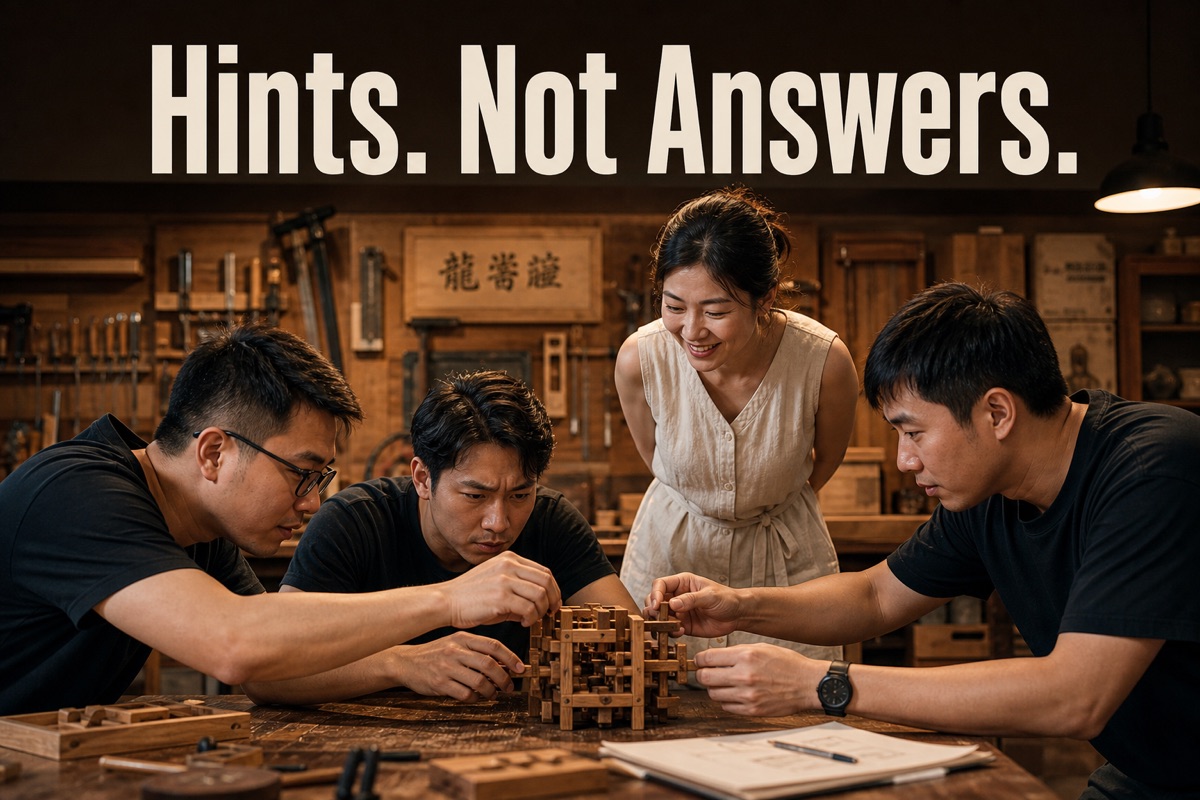
Facilitation, formally: the act of assisting or making easier the progress or improvement of something. Informally, Martin pointed back at the morning's constructive-alignment puzzle — the two flying horses — and asked what he had been doing while we struggled. Walking around. Giving hints. Never the answer. "Facilitation is not telling the answer. If you tell the answer, your whole activity is spoiled." The hints were calibrated in real time, and now I could see the craft in them: you're on a good track. Put the horses back to back — no, not that back to back, on the table. Turn ninety degrees — the other ninety. Each hint moved us one step without taking the step for us, and the delight when the wings finally interlocked belonged to us, not him. That ownership is the entire point: the facilitator engineers the conditions for the group to achieve the thing themselves, keeps it lively, stays curious — and holds the answer back like a poker player. The six roles on the slide — partner, planner, enabler, motivator, task master, guide — are all versions of that restraint. Motivate: you're on the right track, keep moving. Guide: back to back, ninety degrees. Enable: create the conditions, then get out of the way.
Diverge first, then converge
For idea-generation activities the sequence rule is absolute: diverge first, converge after. Divergent mode defers judgement — the goal is as many ideas as possible in a short time, and the facilitator's job is to keep stimulating: don't stop at one idea, write everything. Only when the wall is full does convergent mode start: clustering, selecting, prioritising, until the many become the chosen few. The failure mode, implied but obvious: converging while diverging — evaluating each idea as it lands — which kills the flow of ideas at the exact moment you need volume. The two modes use different tools (brainstorming, mind mapping and SCAMPER to open; dot voting, decision matrices and nominal group technique to close), but more fundamentally they are different social contracts, and the facilitator announces which one the room is in. We had lived this too: Tuesday's course-design morning was one long diverge-then-converge cycle, mind maps first, ten content boxes after.
Tuckman, live-demonstrated on us
Groups have a life cycle, and Bruce Tuckman named its stages in 1965: forming, storming, norming, performing — with adjourning added later. Martin taught it by pointing at us. Monday morning: how many people in this room did you know before? One hand, maybe. That was forming — "some of you asked yourself, why am I here? What am I doing here actually?" — sizing up strangers: this one's an AI guy, that one's a robotics guy, unclear roles, unclear hierarchy at every table. Storming is the power struggle, managed with coaching — and he noted, diplomatically, that our cohort's was mild, but put a senior management team at one table and someone will try to dominate; the facilitator's job is a quiet word: relax, let the others speak too. Norming is the humanising: "you figured out — hey, they are also human. They eat, they drink, they sleep, they have problems like I have." The Monday exercise of sharing why we chose the course was norming by design — surfacing that we all want the same Friday certificate. Performing is when the actual work happens — the mind maps and course outlines on our walls are its artifacts — and the facilitator's advice is simple economics: the faster a group reaches norming, the more performing you get. Adjourning is Friday. What I appreciated most is that every stage had already been facilitated on us before it was ever named — the ice-breakers from Day 1 were forming-accelerators, the expectations round was norming, and none of us noticed the machinery at the time.
The seven tensions
Facilitation is not a list of rules but a set of tensions to balance — seven of them, a framing that comes from Sivasailam "Thiagi" Thiagarajan, the games-based-learning veteran whose name the poster credits. Pace: not too fast, not too slow — speed up for emphasis, slow down for weight. Interaction: not too cooperative, not too competitive — "a little bit of challenge is always good," which is why the cowboy-ninja-bear energizer ran as a two-team contest. Tone: not too serious, not too playful — "if I play games with you the whole time but don't deliver content, there is no meaning in this learning." Structure: firm on time, with a little slack when the moment earns it. Sharing: not too intrusive, not too protective — and when someone's questions wander off-content, gently redistribute the airtime. That one came with a friend attached: Terry, who turns up at sessions Martin moderates, loves to ask questions, and loves equally for them to be unrelated to the content. "That's my good friend. I like you, actually" — delivered to the ceiling, to laughter — but the move is the same for friend or stranger: let others also ask. Focus: results versus process, both, in proportion — Friday needs its result, but not at any cost to how we get there. And concern: the individual versus the group, which turned into the block's best argument.
Never cold-call the quiet one
Is a training good when every person speaks? Is everyone-speaking equal to engagement? The room offered "it depends" — "the safe answer in Asia," Martin grinned — but his real answer came from a master trainer he once studied under, and it was unequivocal: never simply call out a silent person and demand an answer. Why? Because the moment you do, "you spoil their learning." You kick them out of their own learning process. Some people process by listening and taking notes; being suddenly staged is not participation for them, it is an ambush — and Martin confessed the answer relieved him, because in trainings he attends, he too sometimes just wants to listen quietly. Co-trainers push back on him about this — why don't you call on her, she hasn't said anything — and his reply is that speaking is only one of two observable signals. The other is writing. "If people are writing notes, you can relax." The genuinely worrying participant is the one neither speaking nor writing — and even then, the threshold for concern is isolation outside the session: someone alone at lunch, disconnected from every social moment of the course. That is when a trainer should quietly check in. Until then, the silent note-taker is not a problem to fix; she may be your best student. Friday's assessor saw one deliver the best session of her cohort. And a Malaysian classic, told with affection: ask "any questions?" and receive silence; sit down, start packing — and suddenly there are ten people at the front desk wanting a private word. Public silence is not absence of questions. It is a preference about where to ask them.
Case Study
facilitating the AI lab, not teaching it
The hands-on labs in my DJC AI course are where this whole block indicts me. A participant's prompt fails; they wave me over; and because the room is large and time is short, I do the efficient thing — I fix it. Type, hand back, next table. Efficient, and facilitation malpractice: I have been solving the flying horses for them, every single class, and then wondering why the same participants wave me over again twenty minutes later. The answer they never built themselves never became theirs. The redesign is Martin's hint ladder, transplanted. First pass: "you're on a good track — what's missing from the prompt, context or instruction?" Second pass: "read your prompt out loud; would a new staff member know what to do with this brief?" Only at the third pass do I touch anything, and even then by asking them to type. It will feel slower. It is slower — per intervention. Per participant it is faster, because the goal was never a working prompt; it was a participant who can debug their own. Two more transplants. My classes now get an explicit diverge-then-converge structure for the use-case workshop — first ten minutes, every AI use-case they can imagine for their department, no judging, quantity only; then dot-voting down to the three they will actually build that afternoon. I have been letting evaluation leak into brainstorming forever. And the never-cold-call rule earns a permanent place: my instinct in a quiet room has always been to name someone. From now on I watch for the second signal instead — the ones typing notes into their phones are not disengaged, they are engaged in their own dialect. The one to check on is the participant scrolling WhatsApp at lunch, alone, and the check-in happens over coffee, not over the PA.
Reflections
The through-line of the whole afternoon: a facilitator's power is exercised through restraint. Hold back the answer so the group can own it; hold back the cold-call so the quiet can learn their way; hold back your ninety-degree correction until the group's own rotation fails. Every tension on Thiagi's list is a place where doing less, deliberately, produces more. It reframes the trainer types from Day 2 — the performer, the professor, the friend. The facilitator is a fourth thing: a designer of situations who then, crucially, declines to star in them. Watching Martin all week with this lens is like seeing the wires in a magic show — the hints, the walk-arounds, the staged silences were never improvisation. They were the job.