CODE for effective presentation
The last block of Day 3 turned from the session plan to the person delivering it. Dynamic presentation skills, Martin said, come down to four elements he calls the CODE: Content, Organisation, Delivery, Entertaining. Content must be meaningful and related — "if your session is fire extinguisher, you don't talk about robotics, even if you like robotics more." Organisation is the structure we had just spent the afternoon building: opening, development, closing, small chunks in a proper framework, and the same shape recurs at every scale — a fifteen-minute session gets three-nine-three, a whole-day programme gets the same intro-develop-quiz-Q&A anatomy repeated per module. Delivery is body language and the six Ps of the voice. And Entertaining is everything that makes a session alive rather than endured: use of the stage, storytelling, meaningful practice, attitude — and humour, non-negotiable. "As a trainer you must have some jokes, otherwise the session is very tired."
What the audience sees before you speak
Before a word lands, the room has already read you: facial expression, posture, gestures, personal appearance. On appearance, the rule is not corporate uniformity but congruence with the topic. Past cohorts have delivered their Friday micro-sessions in full diving attire, in silat costume, with actual lion-dance equipment in the room — because that is what they would wear doing the real thing. An engineer's KUKA uniform is professional appearance; so are the coveralls his friend wears training offshore emergency procedures for Petronas platform crews, where a suit would be absurd. Dress for the session you are teaching, not for a generic idea of professionalism. On gestures: open hands, always. Open palms invite; pointing accuses — unless it is deliberately playful. His analogy was the old one, delivered with the gesture itself: "I point at one, but three point at me."
The two-second rule
Eye contact got its own numbers. Someone guessed ten seconds was too long, and Martin's reply had the whole room laughing: ten seconds of held eye contact is for "a closed room with a person who has the same ring on the finger." In a training room, more than two seconds already reads as threatening — a stare-down. Less than one second reads as shifty. The sweet spot is one to two seconds per person, and the technique is a scan: start at one side of the room, move steadily across, then drift back, so everyone periodically feels spoken to. And for the genuinely shy, two workarounds I noted down gratefully: look at foreheads instead of eyes — the person still feels seen — or, in a big room, focus at a point far at the back, which gives the whole crowd the impression of being addressed. Eye contact, it turns out, is a technique you can engineer, not a personality trait you either have or lack.
The six Ps of the voice
"Your voice is your most important tool or asset as a trainer." He said it with feeling, because he once lost his voice mid-training — could not talk at all — "very painful for me and the participants." The six Ps (fillers is spelled with an F, he conceded, "but we call it six Ps here"): pitch, pace, pause, projection, pronunciation, fillers. Pitch and pace travel together: high pitch and quick pace transmit energy — his booming good-morning entrance is a deliberate energy transfer, because "what you send to the audience, you get back from the audience." When the room gets over-excited, drop the pitch and slow down, and the room follows. His friend who runs Chinese meditation sessions enters to pounding music — bang, maximum energy — then cools the room down for the meditation itself; the opening is the energy contract. Pause is an instrument: after every question, to give people time to think, and whenever the room is noisy — you cannot out-speak a talking room, but you can out-silence it. Projection came with staging I had never consciously noticed. He presents from the side of the room, so he can glance at his slides while talking to us; but when he asks a question, he walks to the centre, deliberately blocking the screen: now the slide is not important, I am. Position is a signal. Pronunciation: open your mouth; a mumble reaches no one. And fillers — the okays and you-knows — can never be eliminated, only noticed and reduced. His horror story is the online trainer whose every sentence ended in okay, okay, okay — "like a machine gun, seriously." The microphone makes fillers louder than content.
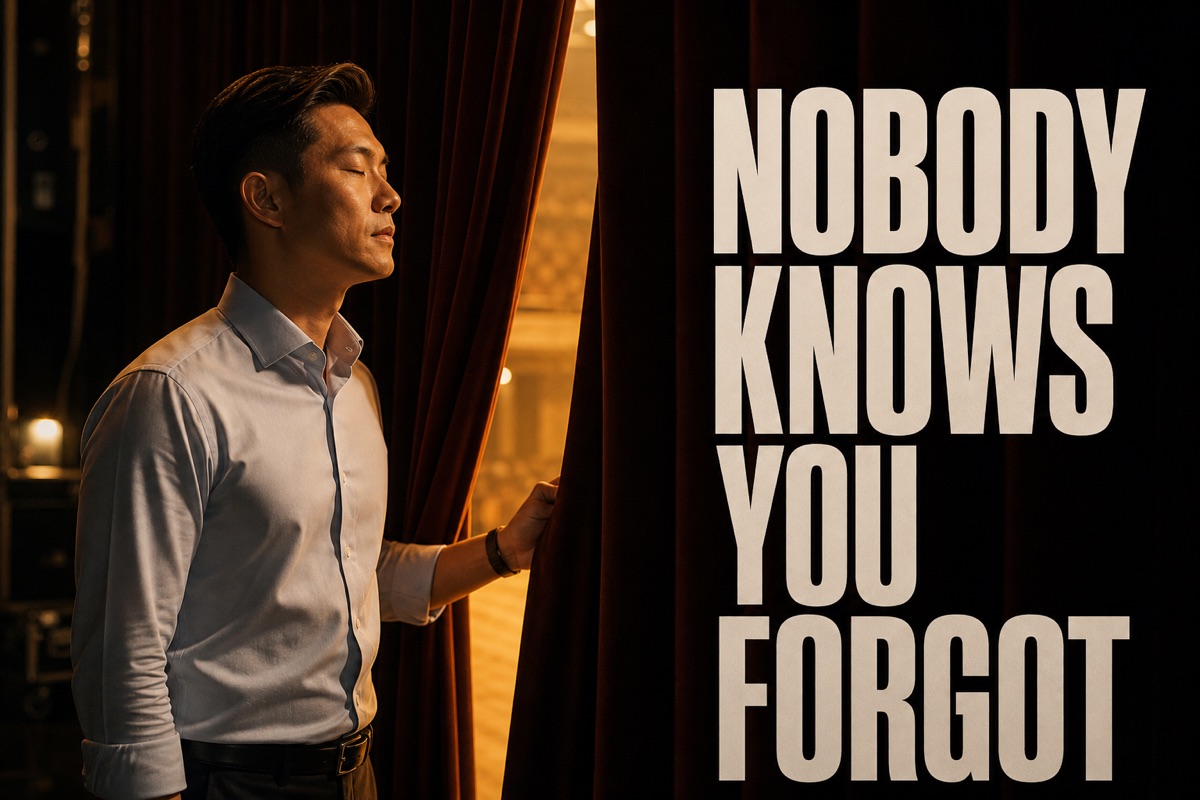
Nobody knows what you wanted to say
Then stage fright, "one of the biggest challenges," and the single most liberating reframe of the course. On Friday, how many people in the room know exactly what we are going to say? Nobody. Not the classmates, not even the assessor holding the session plan: "I have your session plan — I don't know your wording." So the moment of forgetting — the trainer's nightmare — is invisible unless you perform it. "As long as you are not acting that you have forgotten something, nobody knows you forgot something." Skip the point, keep moving, swap sections if you must; the plan is a flow he checks, not a script he follows line by line. If asked afterwards, the honest answers are all justifiable: I adjusted for time, I took that question first. The proof was a story from his industry-4.0 roadshow days. A participant attended his KL talk, then — unknown to Martin — turned up again at the Penang session and came up after: last week in KL you explained it differently; this time I understood much more clearly. Martin's reply: "I improve." The truth, he told us, is that nothing significant had changed except the listener hearing it a second time — but no audience holds a canonical version of your talk to compare against. There is no original. There is only the version you deliver, delivered as if it were always the plan.
Tips, tricks and the three Cs
The preparation advice was disarmingly personal. Martin plays music before every training — his ritual for getting into a good mood. Others do push-ups; he recommends at least some movement before going on stage — a few squats in the washroom, enough to get the blood moving, "ready physically, mentally." Find your own emotional base; everyone's is different. Know the first minutes cold: his opening lines are word-for-word identical every single time — "Good morning everyone, Assalamualaikum, my name is Martin" — a fixed launch sequence that carries him through the coldest sixty seconds, after which "the words come, the cold is away." But memorise only the opening and a few critical phrases, never the whole session. He has watched memorisation fail catastrophically: a trainer so locked to their recited script that when a participant asked a question, the answer was "can I finish my slides first?" A memorised session cannot bend, and training — unlike a speech — is interrupted for a living. Reduce stress ahead of time by arriving early, and his hotel-training routine is pure operations: hotels never set the room up as requested, because the previous event ran until midnight — so he arrives at 7:30 for a 9:00 start, and he always carries chocolate for the hotel staff, who can move furniture faster than any trainer can. Connect before you present: a chit-chat, a cup of coffee with participants — the audience you have made friends with is an audience that wants you to succeed. And when the questions come: cool, calm, collected. They don't know what you meant to say. Two slide-craft rules attached to Friday: the good session plans he showed us ran six or seven slides — seventeen slides in fifteen minutes "never will work." And never end on a video: stopping a video is always a clumsy, fumbling close. Put video at the end of the introduction or the start of the content, where it launches things instead of trailing off.
Case Study
auditing my own delivery
Tonight's audit was the uncomfortable one, because the subject was my own body. I teach the DJC AI course from behind my laptop — which, in Martin's staging language, is a barricade. My eye contact goes disproportionately to the projector screen, which cannot learn. My filler is "basically", and once I noticed it today I heard it everywhere, machine-gun grade. And my energy contract is wrong: I open classes at conversational pitch — a meeting voice, not a training voice — then wonder why the first exercise starts sluggishly. What you send is what you get back. The fixes are all mechanical, which is the good news. Laptop moved to the side table; I present from beside the screen and walk to the centre only for questions — the block-the-slides trick, stolen whole. Opening lines scripted word-for-word and rehearsed until they are a launch sequence, because my first sixty seconds are currently improvised every time, which means my coldest minute is also my least prepared. A pause after every question I ask the class — my current habit is to answer my own questions after two seconds of silence, which trains the room to wait me out. And for Friday's fifteen minutes, the session plan I submitted this week — The One-Minute Poster, participants generating a real workplace poster with AI on their own phones — now gets the CODE treatment on top: the demonstration is the entertaining, the observation checklist is the content, and the delivery gets a two-second eye-contact scan across all twelve classmates, one to two seconds each, foreheads permitted. And one line goes straight into my pre-class ritual, next to the music I have decided to start playing: nobody in the room knows what I planned to say. My worst-case scenario — blanking mid-demo — is only visible if I perform it.
Reflections
Every framework this week has been about the session; this block was about the trainer's body as an instrument — voice, eyes, hands, position, all of it signal. What strikes me is how little of it is talent. The two-second scan, the centre-of-room question, the scripted opening, the pause discipline: these are techniques, learnable in an afternoon, improvable forever. Congruence — Day 2's Carl Rogers post — said the trainer must match the message; today supplied the mechanics of matching. And the stage-fright reframe deserves its own sentence in this journal, because I suspect I will reread it on Friday morning: there is no original version of your talk. The audience receives whatever you deliver as the intended thing. All the terror of forgetting assumes an audience checking you against a script only you have seen. Nobody is checking. Deliver the version you have.