Asking questions properly
The questioning block opened with the trainer's side of the transaction: how to ask. One question at a time — chain three questions together ("what do you think about this? and how do you feel about that? and also—") and the room's working memory drops all of them. Keep questions short and clear; a long elaborate question is a speech with a question mark attached. And distribute — spread questions across the room rather than feeding the same three confident hands, which is the questioning-technique version of Day 1's nobody-speaks-twice rule. Then the tactical fork I had never thought about: when you do want a specific person to answer, do you ask the question first and then name them, or name them first and then ask? Martin made us reason through both. Name-first means the named person braces — and everyone else's mind switches off instantly, "they don't listen to your question now." Question-first means the whole room at least thinks about it — or pretends to — before you pick. Both are legitimate; the difference is how many brains you keep engaged, so question-first is the usual winner. But after yesterday's never-cold-call principle, the deeper rule stands: prefer volunteers, and reserve the direct call for people you know can catch it.
LACAV — the five-step catch
Our workbook teaches the APPLE technique for handling incoming questions; Martin teaches his own variant — "similar attributes" — called LACAV, and he taught it by making us reconstruct each letter. Listen: fully, without composing your answer while they speak — "if you don't listen, you cannot answer." Acknowledge: good question, thank you for that question — not flattery but strategy, because in a training you want as many questions as possible, and every publicly appreciated question lowers the cost of the next one. Clarify: repeat or rephrase — may I clarify, did you mean this? — because answering the wrong question brilliantly is still wrong. Answer: concise, no over-explaining. Verify: did that answer your question? The verify step is where he drew the ethical line. If the participant says not really, the wrong response is the one we have all received: "I think I have already concluded the question — okay, next." "That is a bit rude, to be frank." A follow-up question does not mean your explanation failed; it means their learning is in progress, and you are there to facilitate exactly that. If time genuinely presses, defer honestly — I need to check some resources, let me come back to you — "and then they are fine with that. But never just cut them off."
Six ways to respond, one parking lot
Answering a question yourself is only one of the options. Martin's favourite alternative is redirection: "this is an interesting question — anyone else here want to answer it?" — which converts one person's question into the room's activity, and doubles as a quiet engagement machine. You can probe or rephrase to sharpen what is being asked. You can refer to a resource, which he demonstrated on himself the same afternoon: asked a detail about the assessment, he openly checked his own marking scheme — "I also could not remember anymore." And you can defer — to a later slide, to a break, or to the wall. The wall version is the parking lot, and the scenario that justifies it is universal: the participant who, in the first minutes of day one, urgently asks a question that belongs to day four. The energy is wonderful; the timing would derail everything. So: cards or sticky notes, a visible flip chart, the question parked publicly with a promise — "later I will come to this question." The public part is the design. The asker watches their question exist all day, valued rather than dismissed, and the trainer's agenda survives contact with the room's enthusiasm. The one non-negotiable: actually return to the lot before closing. A parking lot you never revisit teaches the room that parked means buried, and questions stop coming. One special case got its own protocol: the personal question. Someone in a finance training asks what they should invest in; someone in a health training asks about their own condition. Answering properly would require their private details in front of the room, so the move is: "thank you — this is a very personal question. Is it okay if I discuss it with you over a cup of coffee?" Respectful to the asker, protective of their privacy, and honest about why a public answer would be a bad one.
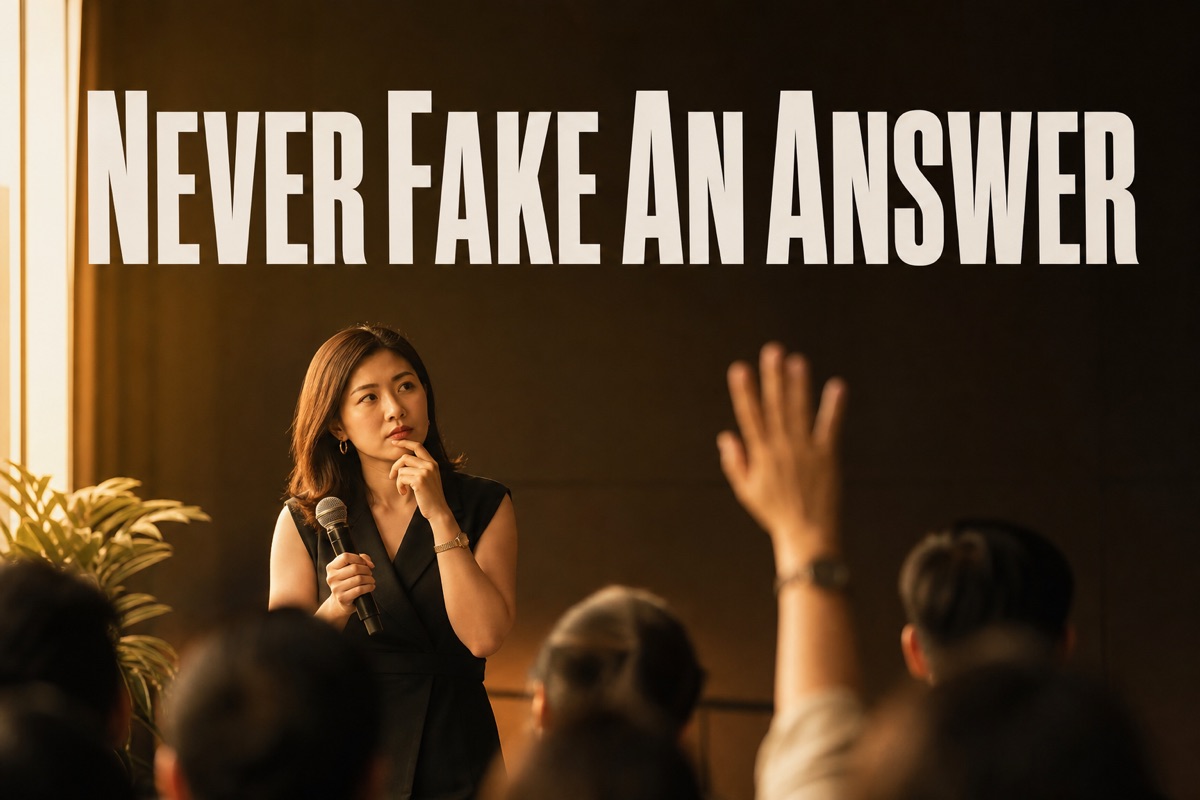
Never fake an answer
The block's hardest rule was also its shortest. When you don't know: say so. "Never, never fake an answer. A fake answer is the worst that you can do — especially in our age, with all these AI. Very easy, people can check." The graceful versions cost nothing: give me a minute to check; I'll come back to you by tomorrow. "If you cannot answer, you cannot answer. You're just a human." What struck me is how the whole architecture of the block supports this rule. LACAV's clarify step buys thinking time honestly. Redirection lets the room carry an answer you don't have alone. The resource-check normalises looking things up in public. The parking lot converts "I don't know right now" into "I will know by four o'clock." A trainer equipped with those tools never needs to bluff — the system makes honesty cheap. A trainer without them will bluff eventually, and in a room where every participant carries a fact-checker in their pocket, one caught bluff costs more credibility than fifty honest deferrals.
Case Study
LACAV at the front desk
Reading my notes back, LACAV is not a training technique. It is a complaint-handling script, and my front desk needs it more than my classroom does. A guest at the counter with a problem — aircon not cold, deposit not refunded, unit not as pictured — currently gets a response that skips straight from hearing to answering: the duty manager starts explaining policy while the guest is still mid-sentence. Which is the exact failure LACAV names: no acknowledge, no clarify, an answer to a question that wasn't quite the one asked, and no verify at the end — which is why the same complaint returns the next day wearing a one-star review. The SOP rewrite drafts itself from the letters. Listen: the guest finishes, uninterrupted, and the DM's first sentence cannot contain the word policy. Acknowledge: thank you for flagging this — genuinely, because a complaint at the desk is a gift compared to the silent guest who complains only on Google, our version of Martin's participants who queue up after the session instead of asking publicly. Clarify: so the issue is the bedroom unit specifically, not the living room one? — half our escalations turn out to be answers to misheard questions. Answer: what we will do and by when, concise. Verify: does that resolve it for you? — asked before the guest leaves the counter, because that is the last cheap moment to find out it doesn't. The parking lot gets hired too, for the weekly ops meeting. Our meetings derail exactly like a training does: someone raises the linen vendor mid-way through the occupancy review, the tangent eats twenty minutes, the agenda dies. New rule — a visible parked-items column on the whiteboard, anything off-agenda goes up with the raiser's name, and the last ten minutes of the meeting belong to the lot. And the never-fake-an-answer rule goes to the front desk verbatim: when a guest asks something the DM doesn't know — visa letters, long-stay invoicing, whether the pool reopens Thursday — the script is "let me check and message you within the hour," never an improvised guess. A wrong guess at a hotel desk is a promise we then have to break.
Reflections
The GLOSS post two days ago established that the Q&A is designed, not endured — seeded questions, staged timing. Today filled in the other half: what to do when the questions arrive. Between the two, the scariest part of Friday — the part where the room talks back — now has more structure around it than any other segment: questions planted, LACAV for the catch, the parking lot for the overflow, and honesty as the fallback for everything else. The deeper pattern is that every tool in this block converts a threat into a resource. A hard question becomes a redirection that engages the room. An off-topic question becomes a visible parked promise. An unanswerable question becomes a demonstration of integrity. The amateur experiences the Q&A as the part of the session they don't control; the professional experiences it as material arriving on schedule. Same room, same raised hands — the difference is entirely in the catching.