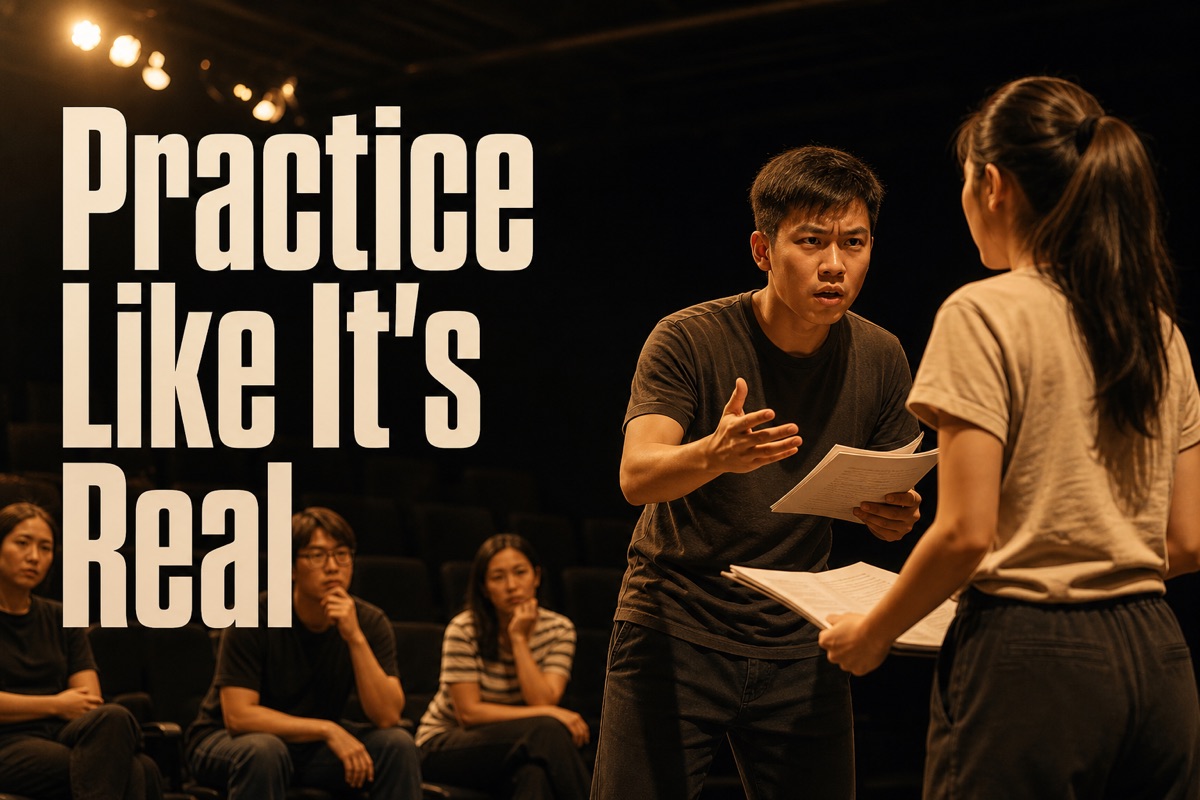
A dramatized case study
The workbook's definition is compact and precise: a dramatized case study — a spontaneous portrayal, an acting out, of a situation, condition or circumstance by elected members of a learning group. Every noun matters. It is a case study, so it exists to serve a learning outcome, not to entertain. It is dramatized, which is its power and its hazard. And the players are elected members of the group — the learners themselves, not the trainer performing. The hazard came first in her commentary: "drama ni boleh jadi out of control. Kalau you tak control betul-betul, dia akan jadi." And the root cause of a role play going sideways is almost always the same — "sebab you tak assign role betul-betul." A vague brief invites improvisation, improvisation invites comedy, and five minutes later the exercise is a sketch show with no outcome. The cartoon on the page makes the same point with children: "I thought we were going to play doctor." "We are playing doctor — I'm a lawyer and I'm suing you for malpractice." Two players, two scripts, no shared brief.
Six steps up the staircase
The workbook draws the steps as a staircase, six treads up: determine the learning outcome for the role play; select a scenario related to that LO; assign roles; brief, discuss and research the roles; showtime; debrief. Reading it as a designer, the striking thing is the ratio — four of the six steps happen before anyone acts. The performance everyone remembers is a third of the method; the outcome is decided in the preparation, exactly as it was in the demonstration module. The two steps flanking the performance carry the safety load. Brief/discuss/research is where control is established — each player knows who they are, what they want, and where the edges of the scenario sit; the gallery-walk group's mind map adds "give time," because a role researched for ninety seconds produces caricature, and caricature is where the stereotyping risk on their limitations branch lives. And debrief is not the cool-down after the method — it is the method. The acting generates raw experience; the debrief is where the experience is turned over, named, and attached to the learning outcome. Skip it, and all anyone retains is who was funny.
Reveal the LO last
Then the rule that reorganised my understanding of every method so far. She lined them up: "Lecture — you bagitahu awal-awal. Demonstration — you bagitahu awal-awal. Discussion — you bagitahu awal-awal. Role play? Tak." In role play — and, we'd learn an hour later, in experiential learning — the learning outcome is withheld. The participants experience first; "bila debriefing, baru you bagitahu what is the LO." The logic is anti-spoiler: announce "this role play teaches empathy for the customer" and everyone performs empathy instead of discovering what they actually do under pressure. The role play needs genuine behaviour to work on, and genuine behaviour only shows up unannounced. What is not withheld is the briefing — "you kena bagi briefing, dan you kena ada debriefing. Ini wajib dalam role play." Both compulsory, but the briefing covers the scenario and the roles, never the meaning. The meaning is the debrief's cargo. My margin-note version: every method announces its destination except the two experiential ones — those hand you the map only after you've walked the ground.
Guidelines — safety first, feedback with a formula
The guidelines wheel: create a safe environment, clear learning outcome, clear role play briefing, specific feedback, structured debriefing. Safe environment leads for a reason — role play is the most personally exposing method in the toolbox. An adult asked to act in front of colleagues is risking face, and andragogy already told us what adults do when face is threatened: they retreat. Safety is built with the scenario (professional, not personal), the casting (volunteers before conscripts), and the debrief culture. Specific feedback came with a callback: "saya dah ajar macam mana nak bagi feedback. Apa formula dia?" — the formula from the 70:20:10 module: start with three things that went well, then what to improve, delivered on the behaviour, never the person. In role play this matters double, because the performance was the person, visibly, in front of everyone. "Structured debriefing" is the same feedback discipline scaled to the group: what happened, how did it feel, what does it mean, what changes on Monday — which is, not coincidentally, the exact spine of the experiential learning cycle that came next in the day.
Case Study
the 11pm double-charge, dramatized
The scenario writes itself from our incident log: a guest arrives at the Mana Mana front desk at 11pm, tired, and discovers the OTA has charged them and so have we. This is our hardest recurring service moment — and currently we train it by me telling war stories, which is a lecture about feelings, the weakest possible method for an affective outcome. As a role play, built up the staircase. The LO — written down, kept in my pocket: at the end of the session, front-desk staff will be able to de-escalate a billing-dispute check-in using the LEARN sequence, keeping the guest at the desk until resolution is agreed. Scenario selected to match. Roles assigned properly, because that is where control lives: one staff member as the guest — with a genuinely researched brief (two flights, a dead phone battery, a screenshot of the double charge), one as the receptionist, two observers with jobs — one tracking words that escalated or calmed, one tracking the sequence against the SOP. Briefing covers all of that. It does not cover the LO. Safety, engineered: the first guest is played by me — the boss acts first, and the room learns that acting badly here is survivable. Showtime, seven minutes, hard stop. Then the structured debrief, in the cycle's order: the players speak first (how did that feel), then the observers' data, then the pattern hunt — and only then do I reveal the LO and we measure the run against it. Feedback by formula: three things that went well first, always. The final twist today taught me: run it twice. Same scenario, roles rotated — because the guest who becomes the receptionist carries the guest's frustration behind the desk with them, and that transfer of empathy is the actual point.
Reflections
Role play completes a pattern I hadn't seen until the trainer lined the methods up by when they reveal their outcome: the further a method sits toward the student-centred end of the spectrum, the later the meaning arrives. Lecture hands you the conclusion before the evidence; role play refuses to name the conclusion until you've lived the evidence. That inversion demands more design, not less — six steps, four of them preparation — and it demands the one thing the dramatized format cannot survive without: a debrief with structure. The drama is the bait. The debrief is the meal.