Two people is a group — but somebody holds the wheel
This was the module where the trainer declared her allegiance: "I like discussion. I like to facilitate." The workbook defines group discussion as a learning experience where a group of people express their varying views to arrive at a conclusion, mutual understanding or clarification of an idea — and she immediately made it operational. Two people is already a group. But varying views plus mutual understanding is not a natural combination — "kadang-kadang kena ada orang ketiga untuk tenangkan: eh, relax, relax." That third person is the facilitator, and without one, a discussion drifts — "kalau tidak, kadang-kadang sembang-sembang lain." The second non-negotiable is a topic. "Kalau tak ada topik, macam mana nak ada views to arrive to a conclusion?" And who designs the topic? The trainer. Which is the quiet theme of the whole methods module: the student-centred methods are not less design work than lecturing — they are more. The trainer's fingerprints move from the delivery to the architecture: the topic, the technique, the time-box, the debrief.
The toolbox — from buzz to fishbowl
The workbook wheel lists six formats, and she walked them with stories. Buzz groups: the conference-hall classic — "can you look at the person to your right and have a small conversation?" From the stage you can't hear words, only a rising hum. "I hear noise. Buzz." That is where the name comes from. Round robin: a topic goes around the circle and every single person speaks in turn, no passing. "Kadang-kadang kita tunggu, dia tak nak bercakap. Bila kita buat round robin, orang mesti cakap — sebab dia terpaksa." Everybody has a voice; round robin is the format that collects it. Brainstorming she treated as a family, not a single method — "mind mapping is also brainstorming; world café is a brainstorming session." This morning's Buzan exercise was a member of it. Nominal group technique is the one she used in her own PhD, and her walkthrough was the full researcher's version: silent idea generation on paper — nobody talks, everybody writes; collect and list every idea anonymously ("nobody knows this idea came from whom"); then everyone votes, rating each idea one to five; average the scores, convert to a percentage, rank — "the top, above 75 percent, only I take." Democratic, silent, and immune to the loudest voice in the room. Her aside made it current: the technique is perfect for the generation that doesn't like to talk — "but they know what's going on, you know? This is a very good way." Fishbowl: an inner circle discusses — the fish in the bowl — while the outer circle watches. "Kalau awak kat luar, awak tak boleh bagi apa-apa idea." Want to speak? Swap in; a fish must come out first. Someone in class asked how that differs from a task force or committee, and the distinction was crisp: a task force's membership is fixed — you cannot tap the Tan Sri on the shoulder and take his chair. In a fishbowl, replacement is the whole mechanism.
Six Thinking Hats — parallel thinking
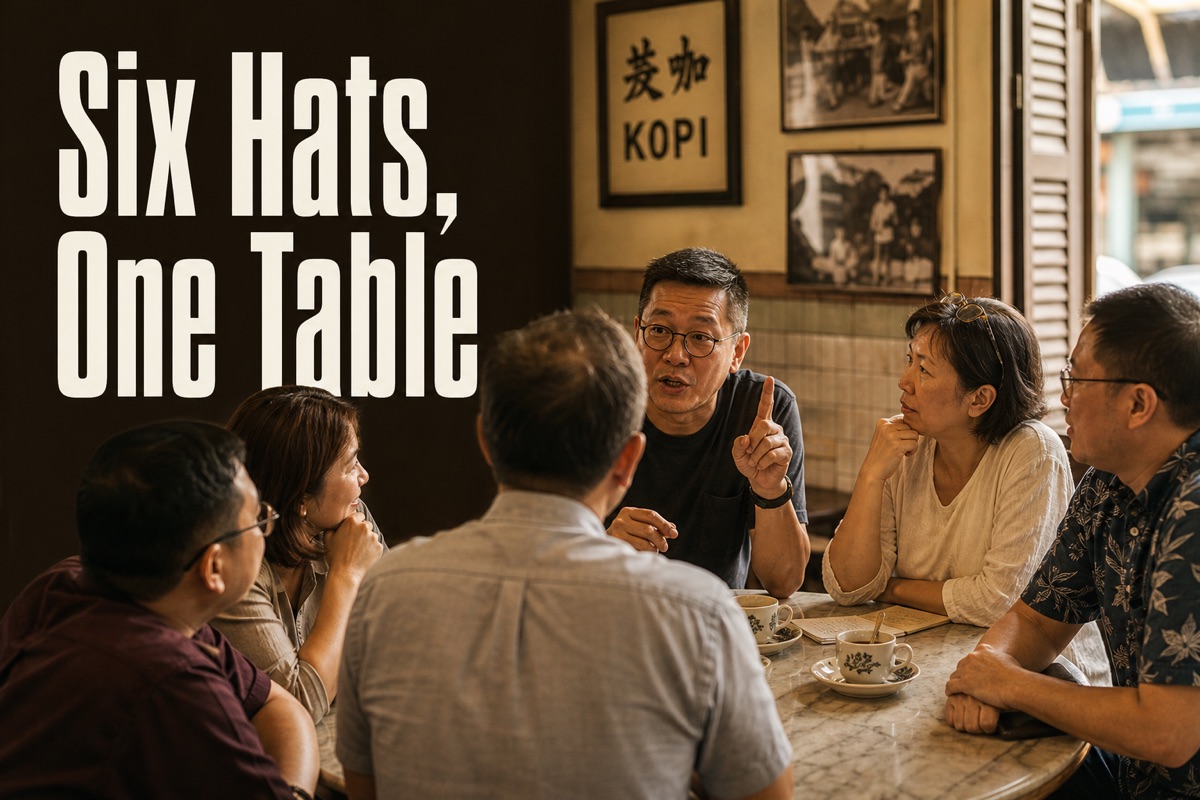
The most famous entry on the wheel got its own act: Edward de Bono's Six Thinking Hats. Her explanation started from mathematics, which is very her: "when you have parallel, the lines don't cross. But the lines don't cross because everybody is thinking on the same gradient." That is the whole method. In an ordinary meeting there is no parallel thinking — one person is generating ideas while another attacks risks while a third emotes — the lines cross, and "pukul sembilan, pukul sepuluh, pukul sebelas — masih lagi meeting." De Bono's fix: everyone wears the same colour hat at the same time. Blue on the facilitator — the control hat. Then the room moves together: white, facts only — "kita generate fact saja, nothing else"; green, opportunities; yellow, benefits; red, feelings — "now, how do you feel?"; black, the cautions and critical points, scheduled so criticism cannot ambush creativity. Each hat gets a time-box — ten minutes, habis, tukar hat. And one procedural rule with teeth: once your turn passes, "no more going back." Say it in the window or hold it. Then the credential: she ran this in a workshop in Thailand with sixty participants from across the ASEAN member states — Vietnam, Laos, Cambodia, Thailand, Singapore, Brunei, Indonesia — many without fluent shared English. "But because I have this, everybody is talking on the same thing. It was really a successful method." Parallel thinking survives translation, because the hat does the coordination that language usually has to.
The Disney method and 6-3-5 brainwriting
Two techniques from her own kit that aren't on the workbook wheel made it into my margin notes: Disney Method, Brainwriting Method. The Disney method (Walt Disney's production practice, later formalised in the NLP literature by Robert Dilts) runs one topic through a relay of separate groups, each wearing a different worldview. First the spectators: given the proposal, they react as an audience would — why not this, why not that. Then a completely fresh group brings the wishes: "I wish to have this, I wish all the good good things." Then the pragmatists: "this one cannot, take this one out; this one can." Then the critics — "they are very talented; they see what will happen" — and from the accumulated views, the movie gets made. The rule that makes it work is fresh people at every station: "another group of people come in, all different people. Because no biasness." Then 6-3-5 brainwriting (the format goes back to Bernd Rohrbach), which she built for us on the whiteboard with the actual template. Six people, a sheet each with a grid. Round one, five minutes: everyone writes three ideas. Pass the sheet to your neighbour. Round two: three more ideas — build on what's already on the sheet, elaborate, but no repeating. Six rounds later: "after thirty minutes, I have 108 ideas. Nobody speaks." Like NGT it is silent and anonymous — use nicknames on the sheets, she advised, if the feedback is sensitive — but unlike open brainstorming it forces building on other people's thinking. Her targeting note is the one I circled: "this is good when you are doing training with top management" — and any room where finance sits next to the people who can't contradict finance out loud. The two structural cousins — NGT and 6-3-5 — solve the same problem from opposite ends: one ranks silent ideas democratically, the other breeds them.
The facilitator's five hats — conductor, juggler, pilot, clown
If the discussion methods are the machines, the facilitator is the operator, and the workbook's five roles each got a live demonstration. Orchestra conductor: "the pace, the momentum, the tempo is controlled by the facilitator" — nobody in an orchestra decides their own bar count. Juggler: in a hot discussion, ideas fly from every direction, "dia punya kerja kutip semua idea" — catch everything, drop nothing. Pilot: the one who knows the destination. "Dia sesat, discussion sesat lah." And everyone in the room had lived that meeting — "orang suruh satu outcome, dia bawa outcome lain. Pernah jadi? Pernah." The clown is the role I didn't expect and won't forget. She asked whether we'd ever seen a facilitator who barely speaks — "mata dia besar, senyum, tak pernah bercakap. Itulah facilitator." The clown keeps the energy warm and the environment safe using face, eyes and presence instead of words — because the cardinal sin of facilitation is joining the argument: "facilitator cannot be involved dalam discussion. Tak boleh." The moment the referee starts playing, the game is over. And finally the pile of different hats: "dia lah mentor, dia lah motivator, dia lah friend, dia lah teacher, dia lah motherly, dia lah fatherly. Semuanya dia." The guidelines page wraps the same discipline in checklist form: incorporate diversity — no one-sided track, no discrimination; demonstrate an open-minded attitude; communicate effectively; manage group dynamics; provide closure. The facilitator sets the rentak — "siapa yang buat rentak tu? Yang jadi facilitator tu."
Case Study
the Mana Mana post-mortem, refitted
Our weekly ops post-mortem at Mana Mana is, if I'm honest, a buzz group with a laptop: I raise an incident, the two most senior voices analyse it, and the front-desk staff — the people who actually touched the incident — nod. Today's toolbox is a direct refit, technique by technique. Incident reviews become nominal group technique. The question — "what caused the double-charge cluster last month, and what fixes matter most?" — goes out on paper, silently. Everyone writes, including the newest hire; I collect, list anonymously, and we vote one-to-five. If a fix scores above the 75 percent line, it goes on the SOP change list with a name and a date. The quiet staff are exactly the demographic the trainer described — they know what's going on; they don't fight for airtime — and NGT is built for them. Big decisions get the hats. The live one: whether to take on a new property's management contract. Our current debate style mixes green and black freely, which means every idea is shot mid-sentence. Instead: ten minutes white (occupancy data, staffing numbers, fit-out cost — facts only), green, yellow, black in their own windows, red — how does the duty-manager team actually feel about absorbing a second building — and me in blue only. That last part is the real reform: in every meeting so far I have been pilot, juggler and loudest participant simultaneously. The facilitator poster says pick a lane; blue is the lane. And for SOP improvement ideas, 6-3-5 at the quarterly meeting: six staff, three ideas, five minutes, six rounds — 108 ideas from a team where perhaps four ever get said aloud, with nicknames on the sheets so the housekeeper can criticise the checklist her supervisor wrote. Silence, it turns out, is not the absence of participation. Badly designed talking is.
Reflections
The through-line of the six techniques is startlingly consistent: every one is a machine for redistributing voice. Round robin forces it, NGT anonymises it, 6-3-5 silences the loud to make room for the quiet, the fishbowl physically walls the audience out of the fish's water, and the hats synchronise everyone onto one gradient. Andragogy said adults need their experience respected; this module supplied the mechanics. And the facilitator roles are the same lesson aimed at me: the room already contains the knowledge — my job is tempo, capture, navigation and safety, not content. The clown who never speaks is doing more facilitation than the expert who never stops.