Different outcomes need different evidence
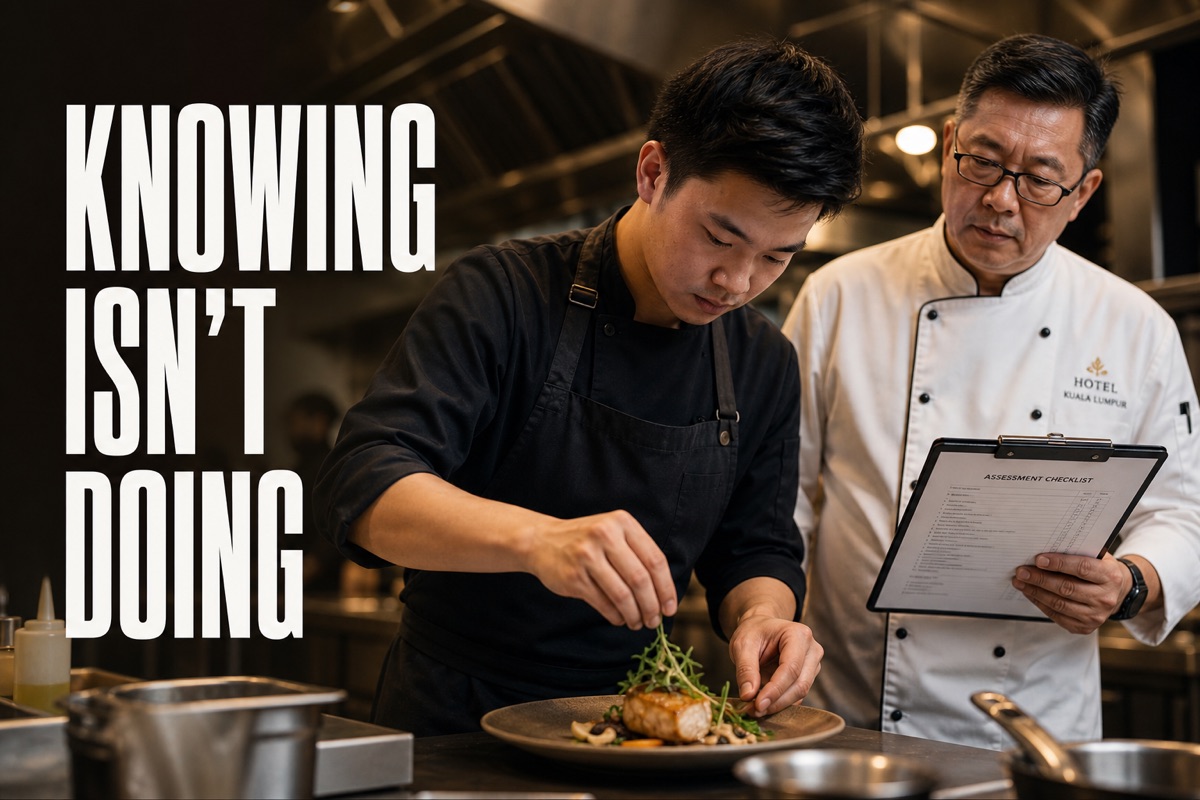
Knowledge assessment answers what they know; performance assessment answers what they can do — and the workbook's warning sits between them: knowing is not always the same as doing. A participant can explain the check-in flow flawlessly and freeze at the counter. For skills-based outcomes, performance evidence is not optional garnish; it is the main evidence, and everything else is supporting material. The tools split by location. Off-job — in the training room: observed practical exercises, simulations, role plays, projects, oral questioning. On-job — at the workplace: training logs, observation of real work tasks, interviews. The link back to Monday's competency-based training session was explicit: this is where the yes/no competency checklist she taught us lives. The demonstration method from Day 2, the role-plays, the return demonstrations — all of that was performance assessment wearing its teaching clothes.
Checklist, rating scale, rubric
Three instruments, in ascending order of resolution. The checklist is binary: behaviour present or absent, yes or no — perfect for procedures where the step either happened or did not. The rating scale adds degree: a zero-to-ten, a poor-to-excellent, measuring quality rather than presence. The rubric adds description: for each criterion, what excellent, good, fair and needs-improvement actually look like, written down — so the judgment is anchored to prose, not to the assessor's mood. Checklist for did they do it, rating scale for how well, rubric for how well, defensibly. The rating-scale masterclass was about the number of points. An odd scale — five, seven — gives a neutral middle, and the middle is where lazy respondents live: "budak-budak semua tengah, tengah, tengah" — tick the centre all the way down, the classic happy-sheet failure. An even scale — four, six — removes the fence and forces a lean. Neither is wrong; it is a choice about whether you want to permit no comment. Her sharper rule was matching scale complexity to audience: distinguishing strongly agree from very strongly agree on a seven-point scale is analytical work — "kalau audience you biasa-biasa, jangan pakai lima tujuh rating scale, sebab dia kena fikir banyak." It is why government surveys collapsed to yes/no: not condescension — response-quality engineering. A scale nobody can interpret produces noise dressed as data.
Selecting the method
With a full toolbox, selection becomes the skill. Seven factors: the learning outcome first and always — the method must let the participant demonstrate that outcome, not a neighbouring one. Then resources — people, tools, budget; the time factor — both conducting and marking, because twenty role-plays at fifteen minutes each is a day; level of difficulty matched to the outcome's complexity; the type of task; the number of participants — a method that works for eight collapses at forty; and retention potential — some assessments teach while they measure, and those earn their time twice. It is the same selection discipline as Day 2's training-methods post, pointed at the other end of the session: no single best method, only a best fit for this outcome, this room, this budget, this clock. And the two selection decisions must agree with each other — the method that taught the skill and the method that assesses it should be siblings, or the constructive-alignment triangle from Day 3 tears.
Planning — five questions
The assessment plan answers five questions before any participant sits anything. What will be assessed — the specific knowledge, skills or competencies, traced to outcomes. How — the methods and instruments. When — the schedule, including the assessment-for-learning checkpoints, not just the finale. Where — location and environment, which yesterday's flexibility examples showed can be moved: bring the hotel to the classroom if that is the fair route. And the assessment criteria — the standards and rubrics that judgment will lean on, decided now, not improvised at marking time. We watched the five questions get answered in real time, because the trainer was briefing our own Friday assessment with them: what — the fifteen-minute training session; how — observed delivery scored on a standard sheet; when — Friday, order drawn by lots; where — this room; criteria — session plan, opening, delivery, engagement, closure, and whether we assess our own participants' learning inside the session. The module is not theory; it is the user manual for what happens to us in two days.
Administering — a fair chance in a conducive room
Administration is where good assessments go to die, so it gets its own discipline. Three conditions: a conducive physical environment — quiet, clean, safe, distractions managed; a conducive psychological environment — anxiety lowered, instructions clear, because a terrified participant is demonstrating fear, not competence; and a fair chance to demonstrate achievement — equal time, equal clarity, consistent paper quality even, because a smudged printout is a disadvantage nobody signed up for. And records, the unglamorous backbone: an attendance record — "pastikan semua sign" — and an assessment record, kept even where marks are not released, "sebab untuk sijil" — the certificate stands on the record. This is the rules-of-evidence post made operational: authentic evidence needs a signature trail, current evidence needs a date, and an audit — HRD Corp or otherwise — trusts files, not memories.
Marking — accurate, consistent, fair
Marking gets a four-step procedure precisely because it feels like the step that needs none. Prepare the answer key — built from the learning objectives, not from what the strongest participant happened to write. Check the answer key — verify it before it grades anyone, because an error in the key multiplies across every script. Score — apply the scheme identically to all, the reliability principle at the level of each tick. Record — accurately, consistently, in a form the certificate can stand on. Behind the procedure, the same lesson as the gemstone and the backwards marker from this morning: consistency is not a personality trait, it is a process property. Marking criteria that live in one assessor's head are unreliable by construction; written schemes, moderated regularly across markers, are how two assessors converge on the same judgment — which is the entire meaning of a mark.
Case Study
a duty-manager assessment kit for Mana Mana
Today's instruments assemble directly into the assessment kit Mana Mana has never had. For the front-desk competency sign-off, three instruments, each doing its own job. The checklist carries the procedure: fifteen yes/no items for the check-in flow — identity verified, deposit explained before the card is taken, OTA booking cross-checked, keys logged. Present or absent, no adjectives. The rating scale carries the soft skills: composure, warmth, clarity, each scored one-to-four — even, not odd, because "okay lah" in the neutral middle is precisely the non-judgment we currently hide behind. And a three-criterion rubric carries the complaint role-play: acknowledgement, resolution, follow-through, each with a written description of what competent looks like, so my two duty managers stop scoring on vibes. Calibration session before first use: both DMs score the same mock check-in, compare, argue, converge — the backwards-marker vaccine. The Likert lesson also just audited our guest survey. We ask guests for one-to-ten ratings on five dimensions; the staff read a 7 as bad news and an 8 as praise with no idea why, and most guests bunch at the meaningless middle-high. Biasa-biasa audience, seven-plus-point scale — exactly the mismatch she warned about. The rebuild: yes/no on the three questions that drive operations (Was check-in smooth? Was the unit as pictured? Would you stay again?) plus one free-text line. Less data, more information. And the records rule closes the loop: each assessment filed with the scored sheets, assessor's signature and date — because the day a guest dispute or an insurance claim asks "was this person trained?", the answer must be a file, not a feeling.
Reflections
The instrument trio is really a resolution dial — presence, degree, description — and choosing resolution is choosing marking cost, which is choosing what I can sustain. The honest insight from today: I default to high-resolution instruments I then never use consistently, when a fifteen-item checklist applied every time beats a beautiful rubric applied twice a year. The other keeper is psychological administration. I have always prepared the material and the paperwork for assessments; I have never once prepared the participant's nervous system. A conducive psychological environment is a real assessment condition — the difference between measuring competence and measuring composure under unexplained stress. Friday will make the point personally: fifteen minutes, drawn lots, scored sheet. I intend to notice what our trainers do to make that survivable — and steal it.