Meaningful and contextual — then SMART
Before the frameworks, two words the trainer says come straight from her own thesis: meaningful and contextual. Every activity you choose, every material you use, every example you give — meaningful, and in context with the training. She repeated it like a chorus, and it turned out to be the test underneath everything else the whole afternoon. Then the workbook's frame for a well-written outcome: SMART — specific, measurable, achievable, relevant, time-bound (the acronym goes back to George Doran's 1981 Management Review piece, though by now it belongs to everyone). What made it click was how little of it survives contact with an actual sentence. Specific is a grammar rule, not an aspiration: "when you want to write a clear, specific outcome, you must write with only three words. Start with a verb, an object, and a qualifier." Repair — not replace, not service, repair. Repair what? A pipe. What kind? Leaking. Repair leaking pipe. My margin notes collect the examples we built: repair leaking pipe, bake cheese cake, use AI system, audit management sys — and the formula underneath: 1) 3 words, 2) verb, 3) object, 4) qualifier (adjective). Measurable rides on the verb: "how do you know you can measure? Because we use an action verb." You can see it, you can hear it, or you can read it — the whistle cartoon from Day 1 again, now as a writing rule. Achievable is about the hidden factors: the same outcome is achievable for one audience and impossible for another, so you check audience, resources and method before you promise anything. And time-bound kills grandiosity: "at the end of the session, the students will be able to audit a management system" — in one hour? "Mana boleh audit dalam masa satu jam." But change the verb and it breathes: list the steps to audit a management system. Same topic, honest scope. The verb is where the ambition gets calibrated.
Three taxonomies — Bloom, Simpson, Krathwohl
"Now I want to introduce you to three taxonomies. When you write outcomes, these are the taxonomies that you must know as a trainer." Then she did something I liked: instead of showing a slide, she made everyone google Bloom's taxonomy and compare the pyramids we each found — some of us got the original 1956 stack (knowledge, comprehension, application, analysis, synthesis, evaluation), others the revised one. Both are correct; the revision came around 2000, when Anderson and Krathwohl anticipated innovation and creativity entering the learning environment and put create at the top: "they already anticipate this — create, evaluate, analyse, apply, understand and remember." The pyramid is really a ladder: "kalau you nak measure tangga yang keenam, maksudnya dia dah kena lepas tangga satu, dua, tiga, empat, lima." You cannot write justify into an outcome for a basic-level course — justify only works when the building blocks below it already exist. Basic courses live at knowledge and comprehension; senior-manager programmes get analyse and evaluate. My margin note draws the bracket: create, evaluate, analyse are HOTS — higher-order thinking skills; apply, understand, remember are LOTS. Her example was driving: you remember the rules, you understand them, you drive (apply). Then one day you analyse routes, evaluate strategies, and finally create your own driving style — the whole taxonomy, lived without noticing. The other two domains have their own ladders. Psychomotor is Simpson's taxonomy (Elizabeth Simpson, 1972), five levels: imitate, manipulate, precision, articulation, naturalisation — and her example was learning a manual car. First day: clutch, gear one, gear two, imitating steps. Then you manipulate the three pedals together — sometimes the engine dies. Then precision, then articulation, and finally naturalisation: "tak kisahlah nak bawa kereta apa pun" — any car, no thought required. The affective domain is Krathwohl's taxonomy (Krathwohl, Bloom and Masia, 1964): receiving, responding, valuing, organisation, characterisation. Her worked example was COVID: first we received information, then we were forced to respond — distancing, sanitising — without really understanding. Then we started to value ("oh, macam ni rupanya social distancing ni"), then we organised — masks in the car, masks in every bag, masks in the pocket — and finally it became character: masuk workshop saja, safety boots on, no thinking involved. In class the two names briefly swapped slides and got corrected on the spot — my workbook margin has Krathwohl crossed out on the skills page and rewritten on the attitude page, which is honestly how I'll remember which is which: Simpson was Bloom's student, and the domains were argued out, not handed down.
The four haram words — LAKU
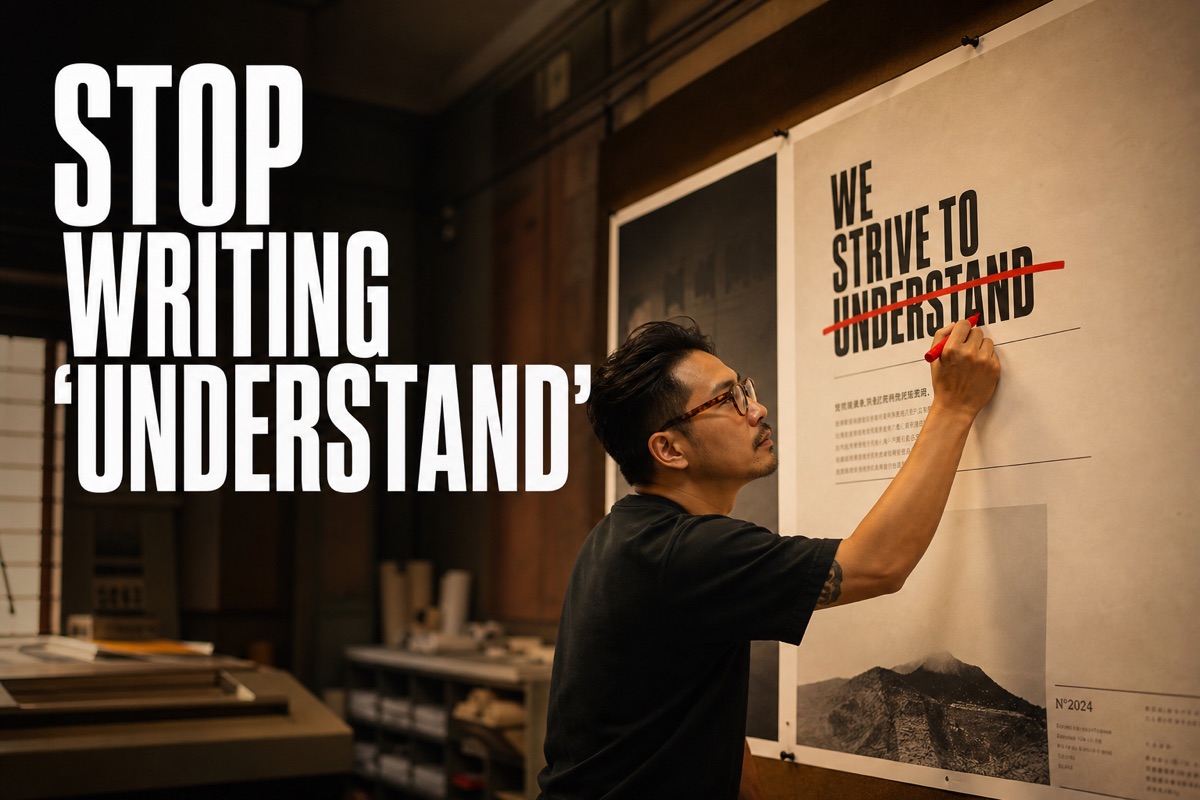
Then the ban list. Some words look like outcomes and measure nothing, and the workbook flags four: learn, appreciate, know, understand. "At the end of the session, the participants will be able to learn…" — learn is a flat word. "Sebab kita tak nampak apa yang dia learn." You cannot see it, hear it, or read it. But if the participant can describe what he learned, you can hear that — so the fix is always the same: swap the flat word for an action verb one level down. Understand got the full theatre treatment. She played the classroom scene every one of us has lived: I assume you all understand. "I don't understand." From where? "From the beginning." — and the whole room laughed because it proves the point perfectly: you cannot use the word understand, because you have no idea what they understand or don't. Appreciate got one line: "how do you show you appreciate?" If it cannot become a visible action, it cannot be an outcome — the same rule as the affective domain this morning. My margin note stacks the four initials into LAKU — and she leaned into the pun, declaring the whole category haram: "laku memang tak laku." In Malay, laku means sellable. These words don't sell. It is the best mnemonic of the course so far because the joke does the remembering for you.
ABCD — and the formula
SMART tells you the qualities of a good outcome; ABCD tells you its anatomy — audience, behaviour, condition, degree (the model comes from Heinich, Molenda, Russell and Smaldino's instructional-media textbook, and certification bodies like JPK and City & Guilds run the same idea as performance–condition–standard; the trainer consults for City & Guilds, certifying institutions from South Africa to Taiwan, and says the benchmark structure is the same everywhere). Audience: who — not what. Behaviour: the verb-object-qualifier from this morning; "kalau repair saja bukan behaviour, tu action word. Tapi repair leaking pipe — ah, itu behaviour." Condition is the MasterChef rule: "MasterChef selalu ada mystery box. You kena masak, tapi you kena guna bahan-bahan dalam mystery box. That's the condition." What the learner is given — and what they are not allowed to use. Degree is the standard: how fast, how often, how correct. She dictated the full formula and my margin note has it verbatim: At the end of the session, the (audience) will be able to (behaviour) using (condition) within (time) / (frequency) / (correctness). The workbook's classic worked example: given a DC motor of 10 horsepower and a kit of tools and references, the student must be able to repair the motor within 15 minutes. Every component present, nothing decorative. Two warnings came with the degree. First: set it from the learner's level, not your wishes — from her days as a manager at GMI, industry partners kept benchmarking diploma students against senior engineers, and she had to push back: "what is the degree you expect at their level?" Set it too high and the failure lands on you — "you have the SMART and you have the ABCD to protect you." Second, the practical rule for time: take how long you, the expert, need — and multiply by three for novices. And one more sentence that connects everything back to competency-based training: "perkataan fail tak boleh wujud dalam kompetensi training." Her proof is WorldSkills: no podium, no first-second-third. If ten participants all meet the benchmark, all ten get gold. The ones who don't are not failures — they are not yet competent, my margin note shortens it to NYC — and they come back next year with more practice. The degree is a benchmark to reach, not a ranking to lose.
Case Study
my outcome, written live and marked
The exercise: everyone writes a complete ABCD outcome on coloured paper — green for knowledge, blue for psychomotor ("kenapa biru? Sebab tu ada blue collar"), and reads it to the room. Mine, for my own DJC course: at the end of the session, the students will be able to construct an AI assistant using DJC AI tools, ChatGPT and Claude, within an hour. It survived — audience, behaviour (construct / AI assistant / working), condition (the named tools — my mystery box), degree (within an hour). But the trainer's feedback was about something I had never considered a design decision: how much to reveal. "Maybe you don't want to list the three tools. You can just say common AI tools" — and put the specific stack on the back of the brochure instead. Her reason was hard-earned: trainers advertise their methods in detail, other trainers read the brochure, and the course walks away. "This person takes my idea — you have to protect your sanity, your emotions." Be selective in the information you release. The outcome sentence is a promise to the participant, but it is also a public document — write it specific enough to be measurable, generic enough that it doesn't hand the competition your recipe. The second thing the exercise taught me: the degree disciplines the promise. My first instinct was "build a complete AI workflow" — but against the multiply-by-three rule, what I do in twenty minutes is an hour for a participant, and that is exactly what the sentence now says. Other people's outcomes made the range vivid: clean river water using soil filters within two hours (an outdoor-education trainer), calibrate a robot servo motor to within three degrees of error (no time pressure at all — the degree is precision, not speed). Same formula, completely different standards — which is the point of the D.
Reflections
Yesterday established that a learning outcome is a promise with a measurement inside; today handed over the machine shop for building the sentence: verb-object-qualifier for the behaviour, a taxonomy to pitch the verb at the right height, LAKU to catch the counterfeit verbs, ABCD to make sure nothing is missing, and the degree set at the learner's level — times three. What stays with me is how protective the frameworks are in both directions: they protect the participant from vague promises, and they protect the trainer from impossible ones.