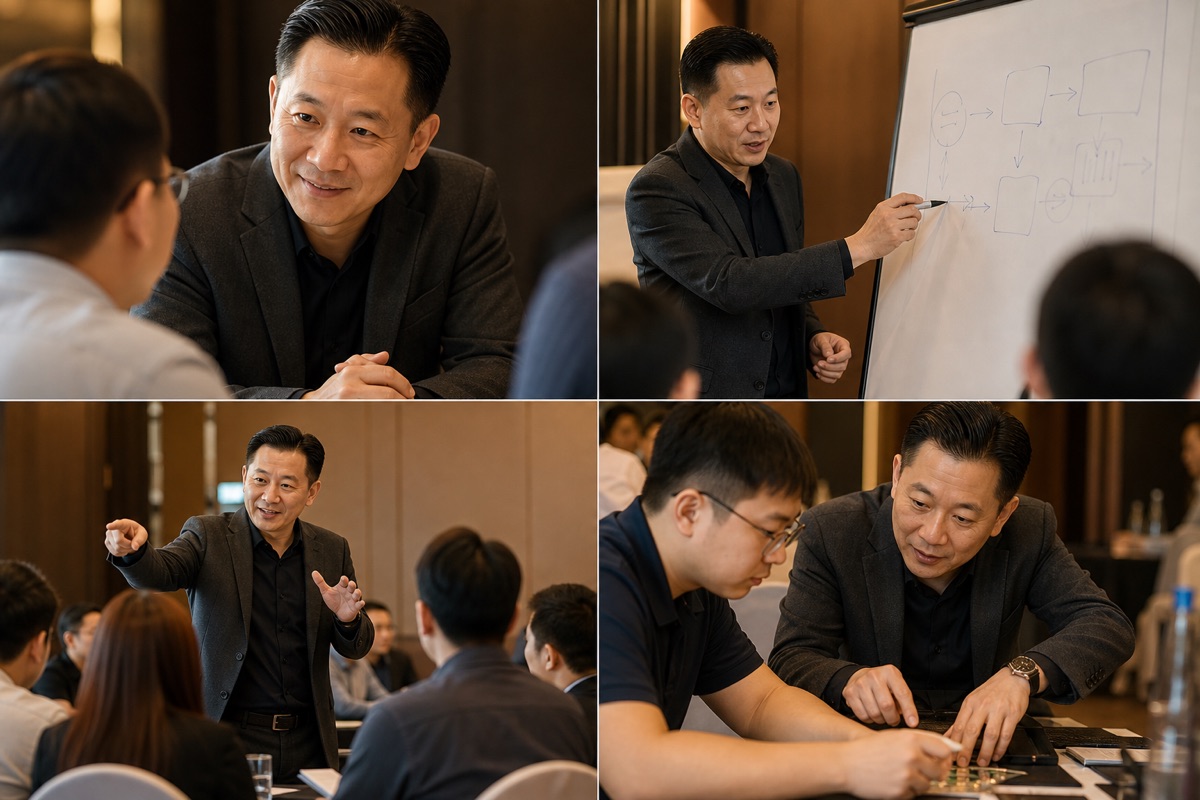
Good trainer = good learner
The bridge into this topic is the workbook's cleanest syllogism: to train well, you need to know how learning takes place; to learn well, you need to know your own habits; therefore, to be a good trainer, you need to be a good learner. The trainer's explanation of why went straight into cognitive science — my margin note says schema: brain structure, assimilate and accommodate. Her version: if your own knowledge is structured clearly in your head, you don't crisscross when you explain. "When you see people explaining in a very clear, structured manner, the schema structure is very good." And when new information doesn't fit the existing structure, the brain adjusts — assimilate and accommodate (Piaget's terms, constructivism's engine). Two practical corollaries she drew: structure your thoughts before you deliver, because the flow is the message; and alter to fit — the same course delivered to operators must be re-shaped for technicians. Same content, different schema to build.
The four types
Just as learners split into four styles, trainers do too — the Trainer Type Inventory (Mardy Wheeler and Jeanie Marshall). Each type creates a different learning environment, and each trains one learning style best: Listener — creates an affective learning environment: encourages learners to express personal needs freely, reads non-verbal behaviour, wants learners self-directed and autonomous. Trains the Activist most effectively. Interpreter — creates a symbolic environment: makes connections, ties past to present, cares about the flow of the training design, integrates theories and events. Listens for thoughts — and often overlooks emotions. Trains the Theorist most effectively. Director — creates a perceptual environment: takes charge, tells participants what to do, is well organised, develops contingency plans. Trains the Reflector most effectively. Coach — creates a behavioural environment: lets learners evaluate their own progress, encourages experimentation with practical application, draws on the strengths of the group, uses activities and problems based on real life. Trains the Pragmatist most effectively. The sting in the model: whatever type you are, three-quarters of your room learns best from someone you're not. The trainer's advice was pragmatic as ever — know your type, then deliberately borrow the other three; and if you don't know, "you general buat" — run a balanced mix. She called the skill of switching modes the art of camouflaging.
Case Study
typing myself before my next course run
No inventory was scored in class for this one, so I typed myself against the descriptions — and my learning-style result (Pragmatist 19, Theorist 17) predicts my trainer type almost mechanically. I am an Interpreter-Coach. Interpreter: I love making connections, I obsess over the flow of the design (this journal is the evidence), I integrate theories — and, damningly, "listens for thoughts, often overlooks emotions" is a sentence someone could have written about me after watching one of my sessions. Coach: real-life problems, experimentation, learners evaluating their own output — that is the DJC AI course's entire mission-based structure. What I am not: a Listener — the affective environment, reading the room's feelings, making space for personal needs — and not naturally a Director either; I under-organise and improvise, which loses the Reflectors who want structure they can trust. So the borrowing plan, one per course run, mirroring my learning-styles commitments: from the Listener, a feelings check-in at the start of each session (one word, how are you arriving?) and actually reading it; from the Director, a printed agenda with timings on every table — trivial for me to produce, disproportionately reassuring for the Reflectors. My Interpreter-Coach core stays; the camouflage grows.
Reflections
This closes the loop the learning-styles post opened: knowing the room's styles matters less than knowing my own, because my type is the default my sessions silently take. The four-type model gives the same discipline from the trainer's side of the desk — and the schema principle underneath it all is the quiet foundation: structure in my head first, then structure in the room, altered to fit whoever is sitting in it.