Where is the gap, actually?
The TNA framework starts from a performance gap and immediately splits into three parallel analyses: organizational analysis, task/job analysis, and person/individual analysis. Together they identify the performance discrepancy and its causes — and only then does the framework fork into a training solution or a non-training solution. The trainer's framing of the three levels was refreshingly blunt. The gap might be in the individual — "kitalah masalah dia." It might be in the process — too long, or with a missing step. Or it might be at the organisational level — infrastructure, systems, digital readiness. Her example: industry-forward-readiness assessments that companies commission. "Dia assess the process dalam organization tu — NOTHING TO DO WITH YOU." A company can fail its digitalisation goal with perfectly competent people, because the gap lives in the infrastructure, not the workforce.
Organisation level — SWOT, PESTLE, and the fishbone
For the organisational altitude the toolbox is classic strategy: SWOT — strengths and weaknesses internal, opportunities and threats external — and PESTLE: politics (government policy, funding, grants), economy (inflation, interest rates, labour and energy costs), social (population, education, lifestyle, culture), technology (emerging tech, information and communication), legal (regulations, standards, employment law) and environment (green and ethical issues, pollution, waste). Then down one layer of rigour: the fishbone (Ishikawa) diagram — machinery, people, methods, materials, each rib carrying causes toward the problem statement — and root cause analysis, illustrated with the best metaphor of the day: a weed. The symptom is the weed above the surface, obvious. The underlying causes are the roots below the surface, not obvious — and the workbook is careful to note that root refers to the underlying causes, plural, not one dramatic culprit. Pull the visible weed without the roots and it grows back — exactly what happens when a company treats a symptom with a workshop.
Task level — DACUM and CUDBAS
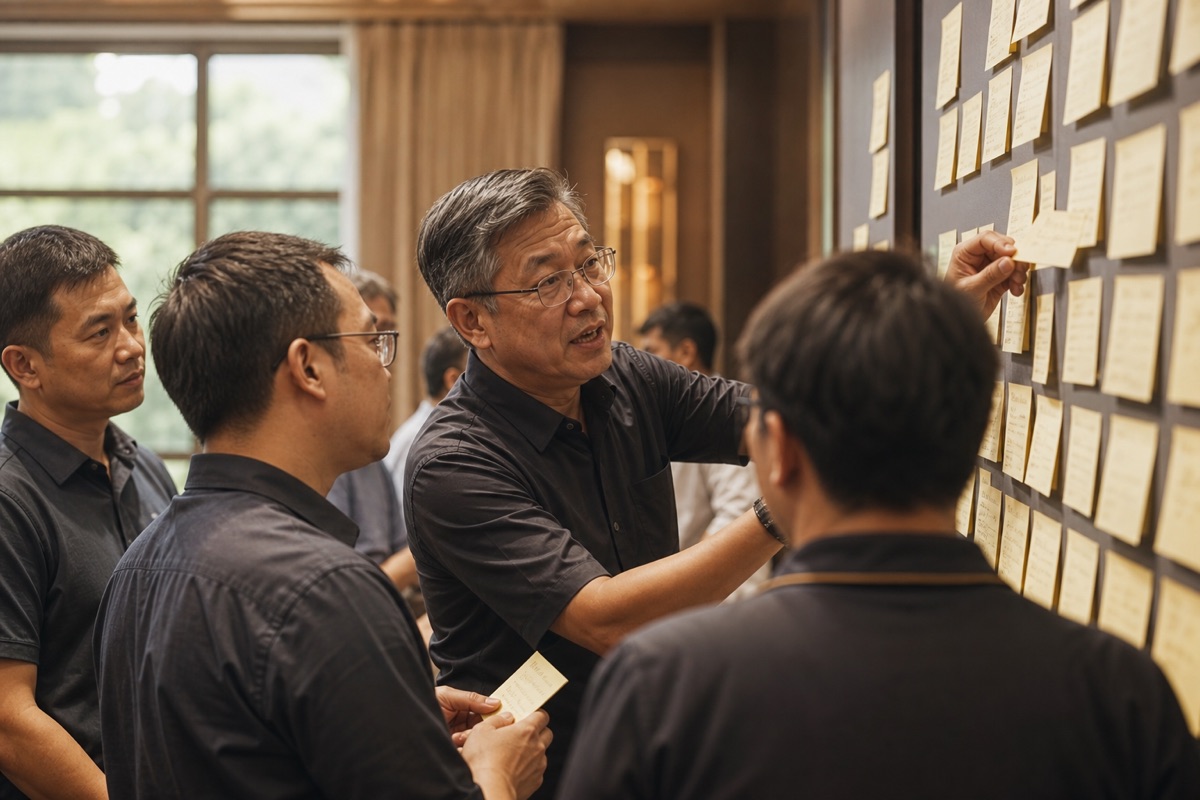
At the task level, the methods are research, observation, and two structured workshop techniques the trainer introduced as "satu dari cowboy, satu dari ninja" — one American, one Japanese. DACUM — my margin note decodes it: Develop A CUrriculuM — originates from Ohio State University. The mechanism: instead of interviewing workers one by one, you brainstorm with a panel of genuine experts. Keep the panel eight to twelve — more and, as she put it, "dia ke laut" (it drifts out to sea). Add two supervisors or a manager so nothing gets missed, and a process facilitator runs the session. The experts write out every task the job involves; the cards on the wall become the curriculum. CUDBAS — my margin note: Curriculum Development Based on Ability Structure — is the Japanese sibling (fully, curriculum development based on vocational ability structure). Same DNA, tighter structure: map the abilities a role requires, then build the curriculum from the ability structure. Two cultures, one insight — the people who do the job, systematically harvested, are the best source of what the job actually requires.
Case Study
three-level diagnosis of our digitalisation push
The trainer's recurring example was digitalisation, which happens to be my day job at Mana Mana. So I ran our own digitalisation push through the three levels, and the exercise redistributed blame in an uncomfortable way. Organisation level, via mini-PESTLE and SWOT: technology — our PMS vendor's API limitations are a hard ceiling no staff member can train their way past; legal — PDPA compliance for guest data shapes what we can automate; economy — labour cost pressure is the whole reason automation matters. SWOT put "founder-dependent tech knowledge" in the weaknesses box, which stung because it is true: I am a single point of failure, and that is an organisational gap, not a staff one. Task level, DACUM-style: I sketched a panel for the reservations role — our three most experienced front-desk staff, one duty manager, me facilitating — to card out every task the role actually involves. Even the dry run surfaced tasks I had no idea existed (manual OTA extranet reconciliations that happen nightly). You cannot digitalise — or train — tasks you don't know exist. Individual level: only after those two layers does "who needs training" make sense. The staff who resist the new tools mostly aren't resisting — they are working around org-level constraints I created. The trainer's line landed personally: sometimes the gap is nothing to do with the people. Fix the roots, then train the weed's owner.
Reflections
The three levels are a discipline against my own reflex, which is to see every problem as a person problem (training) or a system problem (code), depending on my mood. The framework forces the question in order: organisation first, task second, individual last — because a gap misdiagnosed one level down produces a solution that cannot work, however well it is executed.